
If your Wi-Fi doesn’t reach every room, you’ve probably looked at mesh systems. They’re easy to buy and set up, and they do help. But for many homes, especially larger or two-story homes, hard-wired access points are the better long-term answer. Here’s how to decide.
How mesh Wi-Fi works
A mesh system is a main router plus one or more satellites you place around the house. The satellites connect back to the main unit, and your devices connect to whichever unit is closest. Most consumer mesh kits connect the satellites wirelessly.
How hard-wired access points work
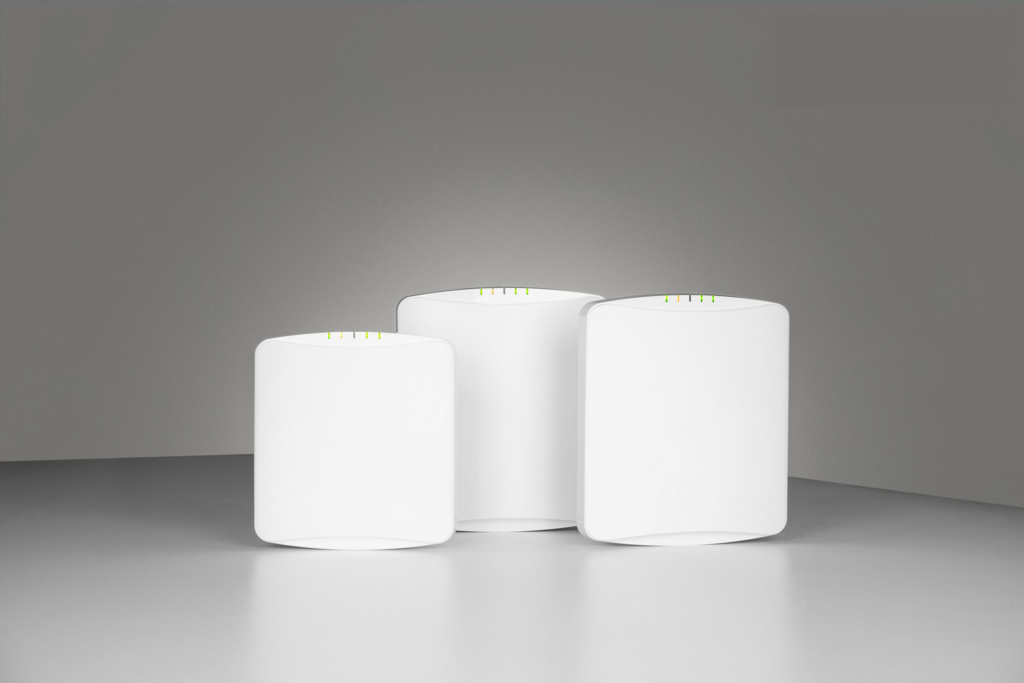
Access points do the same job of spreading Wi-Fi around the house, but each one is connected back to the network with an Ethernet cable. They’re usually mounted on ceilings for the best coverage, powered over that same cable (PoE), and managed together from one app.
The big difference: backhaul
Backhaul is how each unit sends traffic back to the router. With wireless backhaul, the satellite uses part of its Wi-Fi capacity just to relay traffic, so speed drops with every hop, especially on systems without a dedicated backhaul radio. With wired backhaul, every access point gets a full-speed connection back to the network, so the far bedroom gets the same speed as the living room.
When mesh is a good choice
- You rent and can’t run cable.
- Your home is small or a single open floor.
- You need a quick improvement on a tight budget.
- You only need to cover one or two extra rooms.
When hard-wired access points are the better choice
- Larger or two-story homes, or long single-story layouts.
- Home offices where video calls can’t drop.
- Stone, brick or concrete walls that block signal.
- Outdoor spaces like patios, pools and guest houses.
- Lots of devices, including cameras and smart-home gear.
Can you combine them?
Yes. Many mesh systems support wired backhaul, so running Ethernet to the satellites gets you much of the benefit. If your home already has Ethernet in a few rooms, it’s often worth using it.
Our take
Mesh is a fine starting point, but if you’ve already tried it and still have dead zones, more satellites rarely fix it. The lasting fix is fewer, better-placed access points wired back to the network. Renters can still get low-impact options with little or no drilling. For everyone else, see how we design whole-home Wi-Fi.
Dealing with this in Austin or Central Texas? Get a quote or call (512) 748-5916 and we’ll recommend the lightest setup that fixes it.